
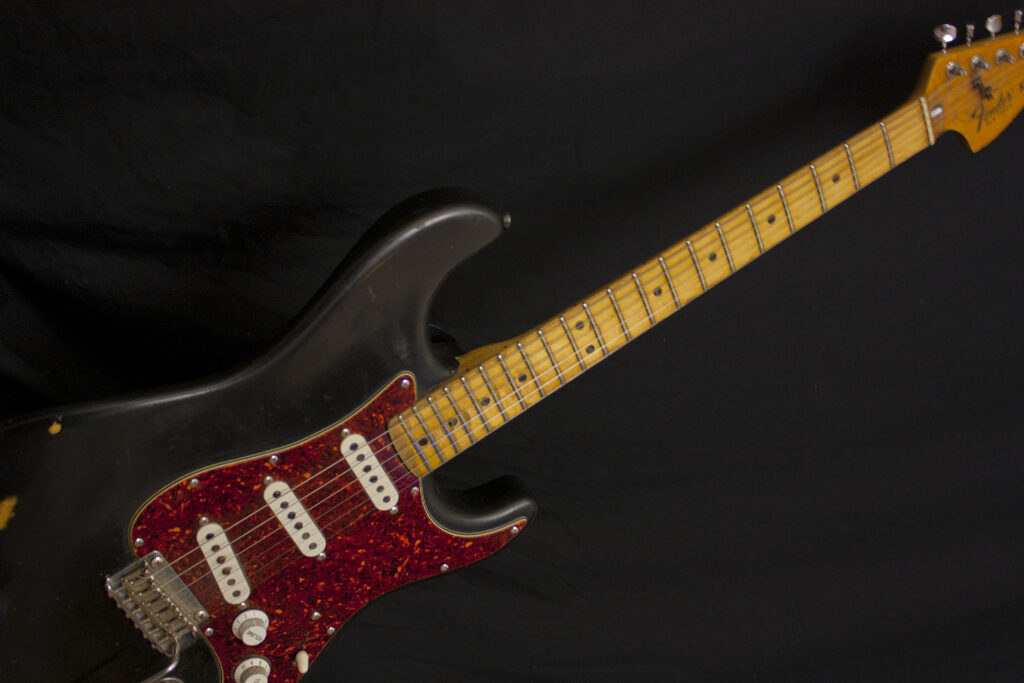
1979 Fender Stratocaster before by John Tuggle, licensed under CC BY 2.0 via Wikimedia Commons.
Fender has recently made waves in the guitar manufacturing world – and it has been met with a lot of resistance from musicians and guitar manufacturers alike. Fender’s recent court case in Germany has recognised that the iconic Stratocaster should have copyright protection. While this may have been an attempt at pushing out cheap Chinese replicas, it has had huge ramifications for guitar manufacturers and vendors across the EU. It has also been widely criticized by musicians as being an aggressive anti-consumer move by the guitar giant Fender.
This all poses the question: Has Fender’s image been permanently damaged by finally choosing to enforce the copyright over a 70 year old body design?
But first, we need to look at the reasons why Fender recently won the case in Dusseldorf, Germany. Recently, there has been a landmark ruling that changed the way in which judges were to interpret copyright law in relation to industrial products. This ruling from the European Court of Justice opened the door to these products being eligible to copyright protections as a piece of “applied functional art”.

Photo: RalfHuels, Düsseldorf Justizzentrum Front Rechts.jpg, Wikimedia Commons, licensed under CC BY-SA 3.0
Fender quickly capitalised on this change in thinking, and went after a Chinese manufacturer – Yiwu Philharmonic Musical Instruments Co, who manufactures a ‘S-style’ guitar. Many other guitar manufacturers, such as PRS or Thomann’s Harley benton also produce ‘S-Style’ guitars. Just a quick point – since “STRATOCASTER” is a trademark, many manufacturers use “S-style” as a way to denote the body shape in question.
Ultimately, Fender won the case – uncontested – and won that the Stratocaster shape should be covered by copyright. I will cover the court case in more detail next week, but for now it is important to know WHY they were given protection after being deemed to have lost its trademark in 2009 in the USA.
Fender’s concerns are not completely unfounded, nor is it likely just corporate greed driving this decision. In recent years there has been a huge rise in cheap clones of Fender and Gibson guitars – mostly made by low-cost manufacturers in China. This has been made possible through the rise of distribution networks such as Ali-Express – the storefront that brought the Yiwu Philharmonic Musical Instruments Co case to Fender’s attention. Fender needed to find a way to protect its interests, and this was handed to them with the change in way the European Court of justice views “functional art”
The court case has sent shockwaves through the guitar manufacturing world, but every action has an equal and opposite reaction. Fender’s assertions over the stratocaster design has been met with backlash throughout the musical world. Fender, once the pioneer of electric instruments, hurt its own image by trying to change 70 years of investment into a specific shape of guitar body by countless large scale and boutique manufacturers alike.
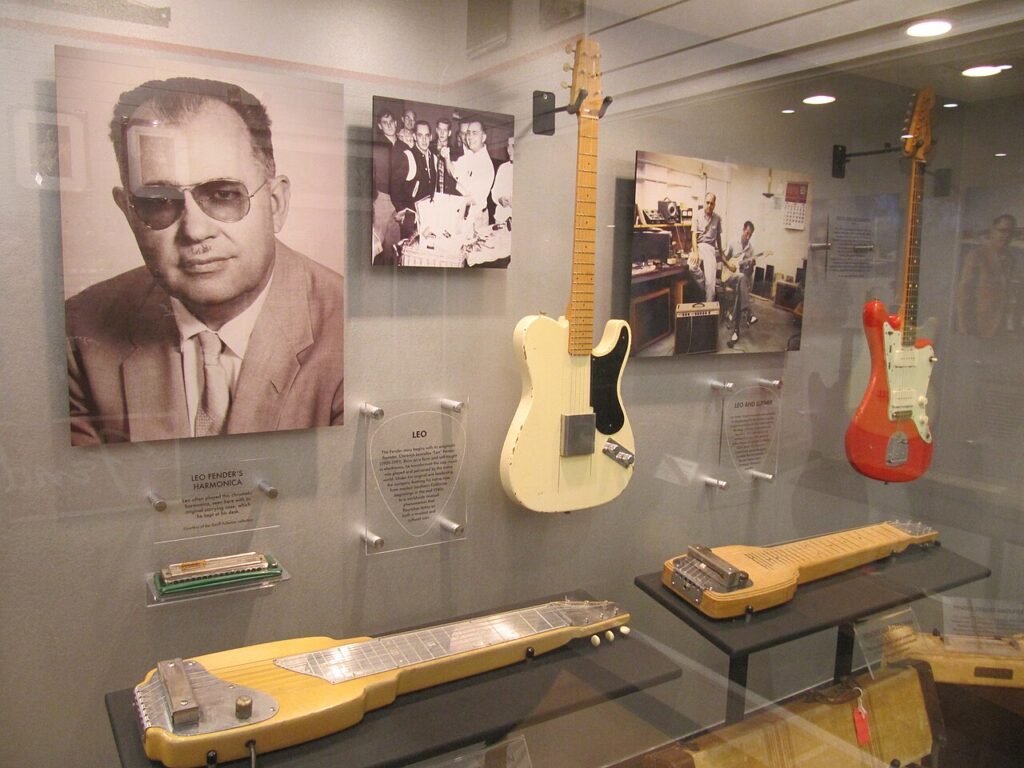
Photo: FGF museum 01. Leo and early models by Clusternote, via Wikimedia Commons. Licensed under Creative Commons Attribution-ShareAlike 4.0 International (CC BY-SA 4.0).
Many guitar players – myself included – feel like this is a hostile anti-consumer measure by Fender. And let’s face it, in the music industry, image is everything. Fender may have established legendary status – with endorsements from Buddy Holly, Jimi Hendrix and countless others over the years. It is fair to say that Fender has become as much a lifestyle brand as it is a manufacturer. And yet, they may have thrown it all away.
Could it be that this titan of music has just thrown it all away overnight? While Fender has become the pinnacle of guitars in genres spanning from rock and roll to country, it may have signed its own death warrant in genres that have a DIY attitude. Could we see a world where Fender is shunned in music scenes that value rebellion, individuality and independence?
Well, quite possibly. This is the type of anti-consumer behaviour that is likely to damage Fender’s reputation, especially in Punk Rock and Metal circles. The reality is that Fender, which along with its subsidiaries owns nearly half of the market share of guitars, is attempting to bully smaller manufacturers into submission. This is certainly guaranteed to cause some push back in these groups – but could we see the brand itself ostracised from these genres?
I would hope not, Fender has been an icon since the Broadcaster in 1950, which became the Telecaster in 1951. However, its reliance on maintaining its vintage image might be one major part of the problem. It hasn’t had a major change in line up from when Leo Fender sold the company to CBS in 1965. That was until the introduction of the Meteora range in 2022. There is an irony that Fender’s biggest innovation in my lifetime looks like a rip off of Gibson’s Thunderbird, and is named after a Linkin Park album. It also goes to show just how much Fender has coasted on the legacy left by its founder.
In all honesty, it isn’t hard to see why some young guitarists are calling Fender a ‘boomer brand’ – they have been coasting on designs left to them by the legendary Leo Fender. With the rise in popularity of other brands such as Ibanez and Schecter, it is obvious that Fender’s saving grace is its subsidiary Jackson, that still allows it to compete in the high gain world of heavy metal.
Let’s move on to the way it’s been received by other manufacturers. The largest names yet to be hit by Fender is none other than PRS – Fender has served a cease and desist over the firm’s Silver Sky guitar – and Yamaha. This follows Harley Benton’s cease and desist letter being issued by Fender alongside numerous small boutique manufacturers. Fender, desperate to maintain sole rights over the ‘s-style’ shape, has begun to try to enforce this new ruling to other firms…
What they didn’t count on is for people to fight back. Thomann, who owns Harley Benton, has already pledged to dispute the original ruling in favour of Fender. Given that this will be the first time there will be a defence against the ruling, lawyers are speculating that this next case will be more important than the previous ruling. But let’s not get dragged into that debate until next week, when we look at the case itself.
What is worth mentioning here is the lack of trust we are likely to see from vendors who have a vested interest in seeing Fender lose once they have appealed. In this section we will take a look at Thomann, what it could mean for their relationship with Fender.
Thomann, as I have mentioned, owns the Harley Benton brand. Many of the guitars Harley Benton produced could be in violation of this copyright finding. Furthermore, many of the guitars Thomann sells are going to be ‘S-Style’ bodies. If they were to be unable to sell a large chunk of their inventory – or redesign the products they make – it is likely to strain relationships between Fender and Thomann. This relationship exists between many other stores, big and small alike.
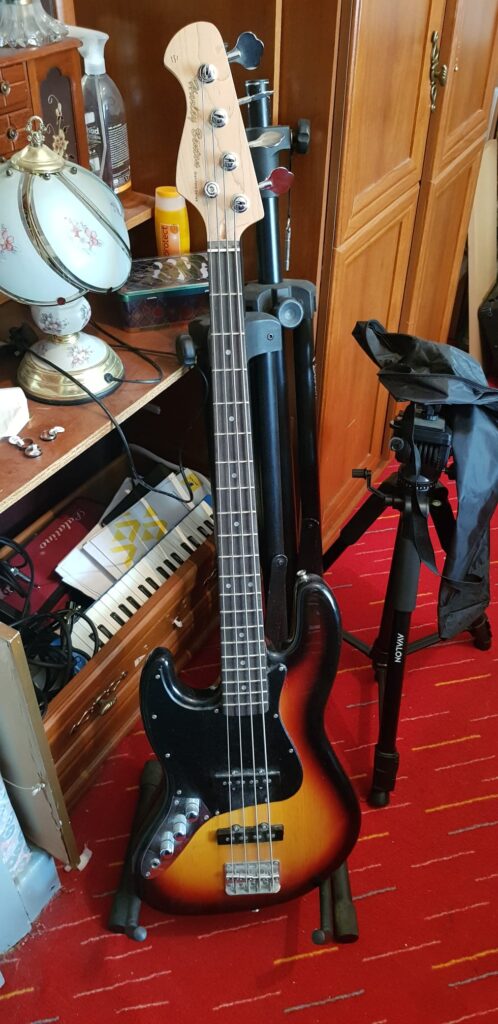
Could we see a boycott of Fender products on these platforms?
Probably not, Fender has a very loyal fan base, who are unlikely to shift their preferences. What is more likely to happen is that many firms will join together and tie Fender’s money up in years of litigation as this case goes through court. Maybe it is more likely to hurt Fender through investor confidence. Especially if they were to lose their copyright case, which is still very much a possibility.
Ultimately, this is likely to be one of the largest gambles in Fender’s history. The company may have succeeded in strengthening its copyright protection over its most iconic design – probably the most recognisable design in guitar history. Commercially, however, the cost could be far higher than the courtroom victory.
The Stratocaster, in its 70 year run, has become more than just an instrument. It has become the first image that comes to mind when you think “guitar”. Seriously, search for the guitar emoji – it is a ‘s-style’ guitar. That is without mentioning its countless appearances in movies, album covers and even kids drawings. Pair this with the fact that so many luthiers have followed suit and produced their own ‘s-style’ bodies and you can see why there is so much animosity towards this decision.
Regardless of whether the copyright claim is upheld, the court of public opinion might be what seals Fender’s fate. This could be the end of Fender having any foothold in punk or metal circles. Every cease and desist, lawsuit and damaged distribution relationship risks reinforcing the perception that Fender has become more interested in protecting its past than inspiring the future.
The greatest irony of the case is that Leo Fender was one of the greatest innovators of his time. And yet the company that carries his name will be remembered not as an innovator, but as the brand standing against it.
Leave a Reply